
Google Analytics helps track user interactions on your website, providing insights into traffic, behavior, and conversions. If you're using Cursor, an AI-powered developer tool, integrating Google Analytics will require adding the tracking script manually.
- Create a Google Analytics account
- Get your Google Analytics measurement ID
- Add the Google Analytics tracking code to Cursor
- Verify the setup
- Final Thoughts
Before we dig in I want to show you something. I promise it's worth it...
Google Analytics is great, but also complex and a bit clunky. If you just want a straightforward dashboard with the insights you need, GA is not a great place to start. Additionally, Google doesn't care about privacy and GA requires an annoying cookie banner.
That's why we built Simple Analytics, a privacy-friendly and simple analytics tool - no personal data, no cookies, just the insights you need in a straightforward dashboard.
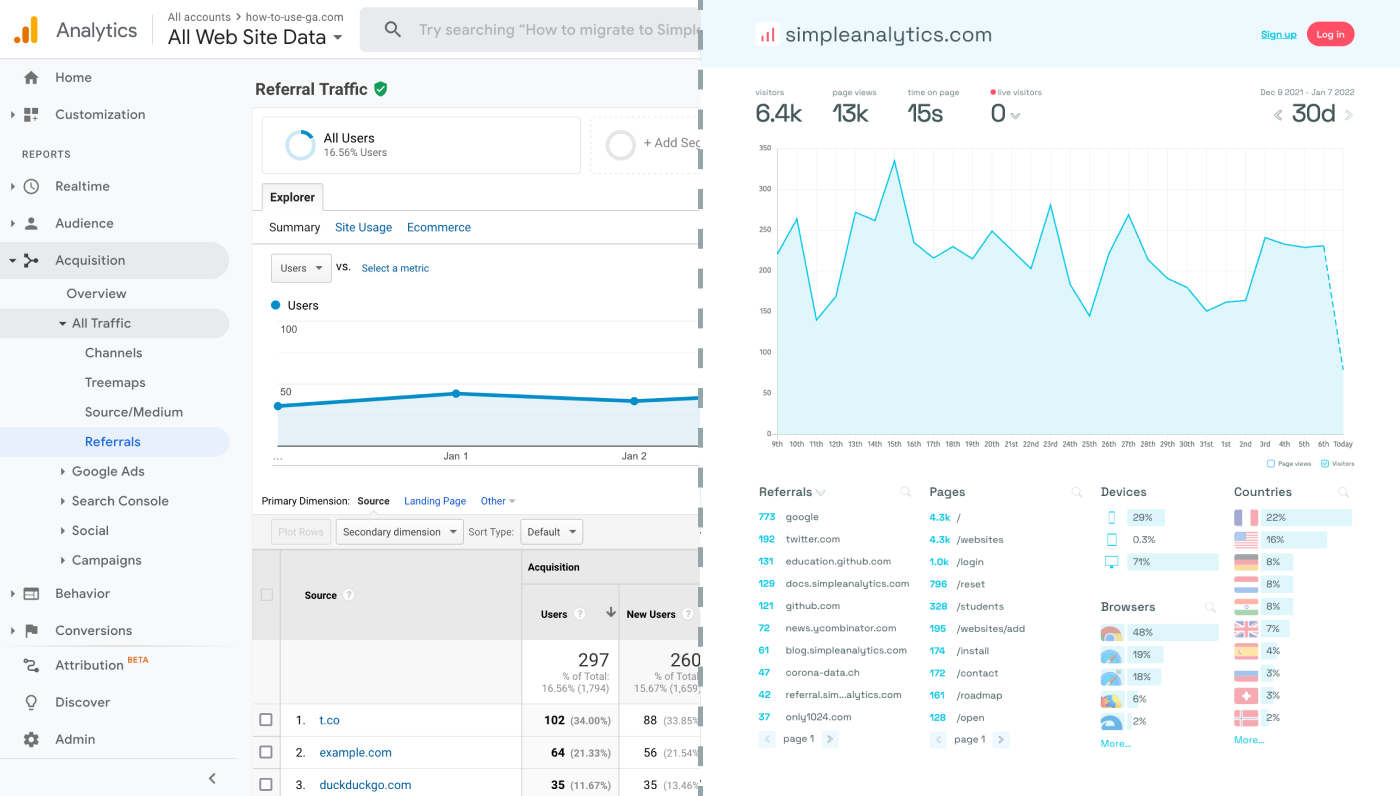
Here is how it looks vs GA. Feel free to check our live analytics to get an idea for your project. (It is free btw)
All right, enough about us. Now let's get into answering your question!
Create a Google Analytics account
If you haven’t set up Google Analytics yet, visit Google Analytics and create a property for your website.
Get your Google Analytics measurement ID
Once your property is set up:
- Navigate to Admin > Data Streams.
- Select your website property.
- Copy the Measurement ID (e.g.,
G-XXXXXXXXXX).
Add the Google Analytics tracking code to Cursor
If Cursor allows adding custom JavaScript or modifying the HTML <head>, follow these steps:
- Open your Cursor project.
- Locate the HTML template or a section where you can insert custom scripts.
- Paste the following Google Analytics tracking code inside the
<head>section:
<script async src="https://www.googletagmanager.com/gtag/js?id=G-XXXXXXXXXX"></script>
<script>
  window.dataLayer = window.dataLayer || [];
  function gtag(){dataLayer.push(arguments);}
  gtag('js', new Date());
  gtag('config', 'G-XXXXXXXXXX');
</script>- Replace
G-XXXXXXXXXXwith your actual measurement ID.
Verify the setup
- Open Google Analytics.
- Navigate to Reports > Real-time.
- Visit your site and check if activity appears in the real-time data.
Final Thoughts
Integrating Google Analytics with Cursor requires adding the tracking script manually. If you're looking for something simpler and privacy-friendly, check out Simple Analytics. We provide insights without needing a cookiebanner on your website. Straightforward and privacy-friendly analytics.