
If GA4 reports fewer pageviews this month, has your audience changed, or has your measurement changed? A single dataset can make those two questions difficult to separate.
Hebban, the Dutch book community, ran Simple Analytics alongside GA4. The comparison showed substantially different pageview totals. It is a useful example of why an analyst might want an independent traffic baseline, with some important limits on what the numbers prove.
What the Hebban comparison shows
The setup described in our original case study kept GA4 behind the consent banner and ran Simple Analytics independently of that consent choice.
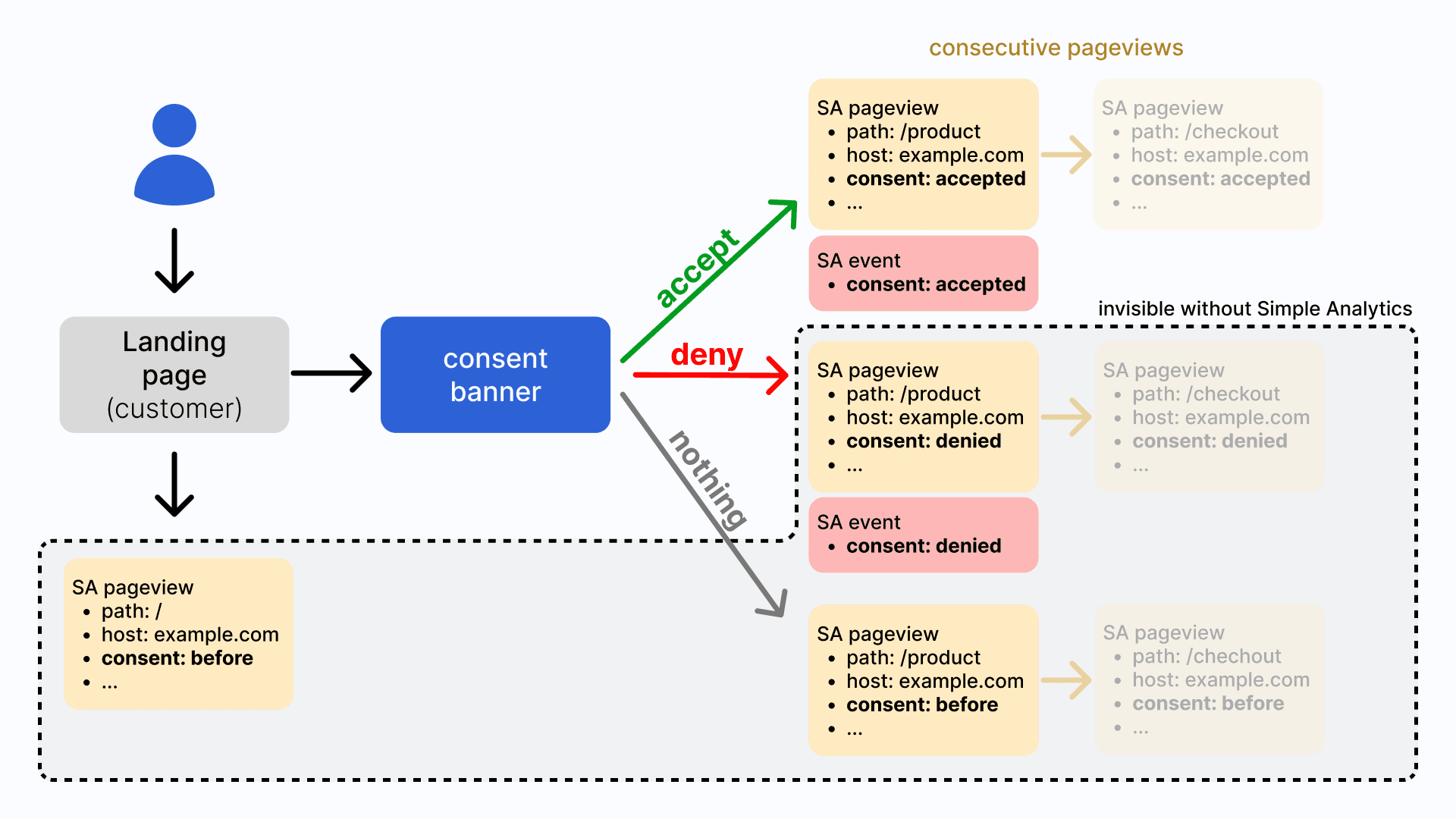
In this setup, Simple Analytics recorded each pageview with the visitor's consent state (before, accepted or denied), and an event when a choice was made. The dashed area marks pageviews GA4 did not receive in Hebban's configuration. With advanced Consent Mode, GA4 can receive cookieless pings for part of that traffic, as explained below.
| Measurement | Reported pageviews |
|---|---|
GA4 page_view event count |
Approximately 1.6 million |
| Simple Analytics pageviews | 2,031,468 |
| Difference, using 1.6 million for GA4 | Approximately 431,000 |
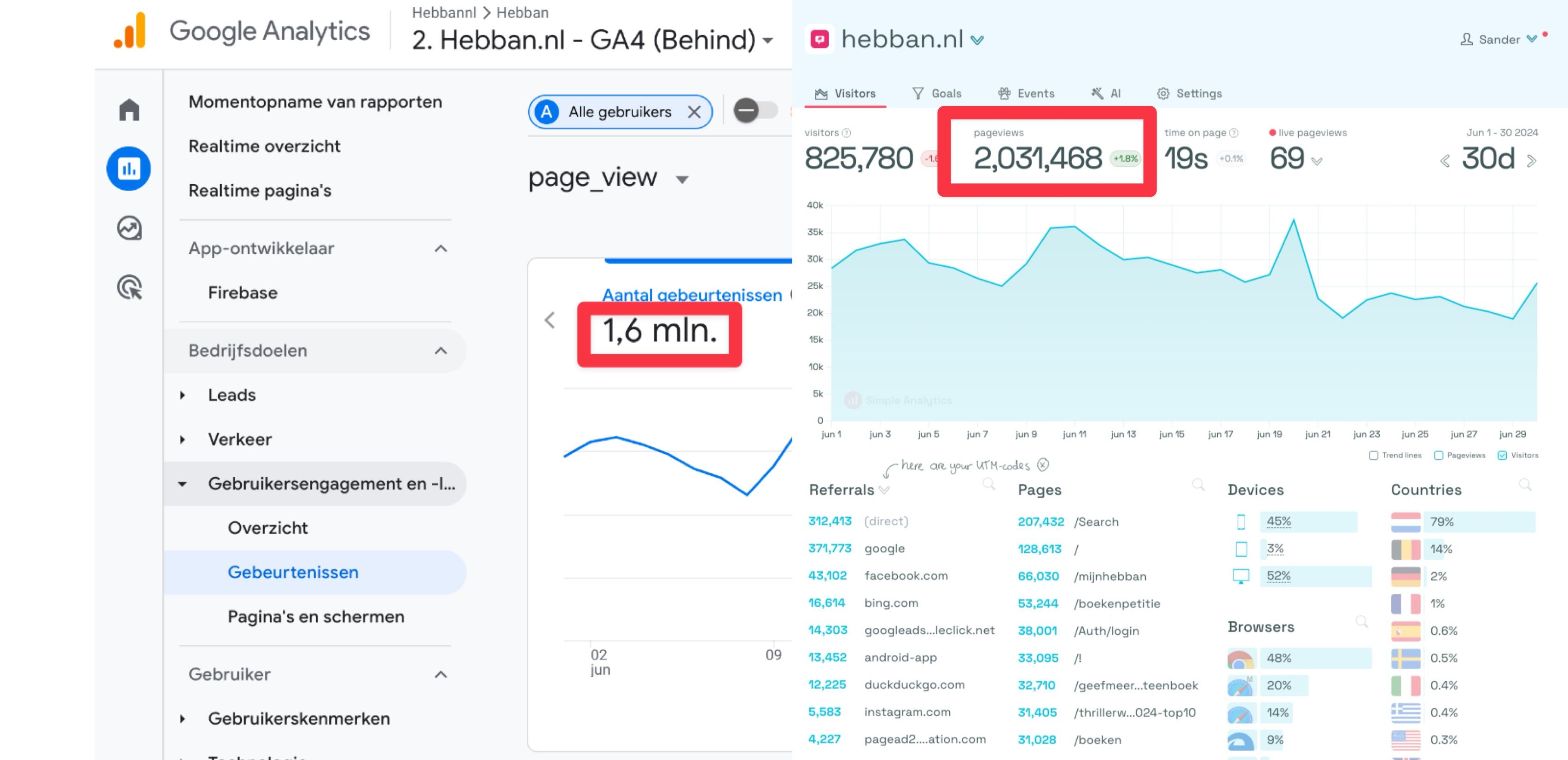
The Simple Analytics screenshot covers June 1–30, 2024. The full GA4 date selector is not visible in the published crop, and its event count is rounded. Treat these as the reported case-study totals, not a comparison reproduced from raw exports.
Using those displayed values, GA4's count is approximately 21% lower than Simple Analytics' count. Expressed the other way around, Simple Analytics reports approximately 27% more pageviews than GA4. The denominator changes the percentage.
Neither calculation tells us that 21% of visitors rejected consent. These are pageviews, not people or consent decisions. Nor does the difference alone establish how much came from consent, blocked requests, tag coverage, duplicate events or reporting settings.
Why keep a second traffic baseline?
GA4 remains useful for questions that depend on its user and session model. A separate pageview dataset gives the analyst another way to check traffic volumes.
Simple Analytics records pageviews and events without a persistent visitor identifier. Its collection does not depend on Google Consent Mode modeling. It also calculates session starts from pageview context, but those are not interchangeable with GA4 sessions. For this comparison, keep the unit as pageviews. How Simple Analytics measures sessions without consent.
The practical benefit is a second reference for reporting. You can compare pageview trends while keeping GA4 and your consent banner in place. You are not importing the difference into GA4 or reconstructing the missing visitors' journeys.
That baseline still needs a working implementation. A request that never reaches Simple Analytics cannot be counted. Changes to tags, page coverage, filters or delivery can change its totals too.
Is traffic down, or has measurement changed?
The published Hebban comparison shows a difference in totals. It does not document a traffic decline or prove what caused a trend to change. To investigate that question on your own website, compare both datasets over time.
Start with the same dates, time zone, hostnames and page scope. Check that each tool records the intended pageview once, including client-side navigation. Note deployment dates, CMP changes, consent rates and any changes to reporting settings.
Then look at the pattern:
- GA4 falls while Simple Analytics stays broadly stable. Investigate GA4 collection, consent behavior and reporting changes before concluding that the audience has shrunk. Also check whether the two tools cover the same pages.
- Both fall over the same period. That is consistent with lower traffic, but check for a shared implementation or site availability problem before treating it as confirmation.
- The difference changes for particular pages or devices. Inspect those segments. A single site-wide percentage can hide a collection problem affecting only part of the site.
These are investigation paths, not automatic diagnoses. Keep a change log so that an unexplained movement can be checked against what actually changed on the website.
Consent Mode changes what you are comparing
The Hebban setup described above should not be generalized to every GA4 implementation. With basic Consent Mode, Google tags are blocked until consent. With advanced Consent Mode, tags can send cookieless measurements when analytics_storage is denied. Google's Consent Mode overview.
Eligible properties can use behavioral modeling to estimate behavior for traffic without analytics consent. Check the report's data-quality information and reporting identity rather than assuming that every GA4 number is consented-only or modeled. Google's behavioral modeling documentation.
For a POC, record those settings before comparing totals. “GA4 versus Simple Analytics” is not a sufficient description of the measurement methods.
Use the baseline without overstating it
A pageview comparison can help explain reporting coverage. It cannot tell you how the unobserved population converted, whether it behaves like the consenting population, or which earlier campaign led to a later purchase.
Do not multiply every GA4 metric by the pageview ratio. That assumes the same coverage and behavior across users, channels and conversions. This case does not establish those assumptions. If you use the baseline to extrapolate, make the assumptions explicit and evaluate them for the metric in question.
The useful next step is to measure your own difference. Agree on the question first: a pageview baseline, a change in traffic trends, or a discrepancy in campaign reporting. Then compare the datasets and investigate what they can and cannot explain.
Free 30-day proof of concept
Compare Simple Analytics with GA4 on your website
Run a free 30-day proof of concept alongside your existing GA4 setup and CMP.
We help you:
- Agree on the measurement question, metrics, pages and comparison period.
- Set up Simple Analytics, including support for proxies and custom domains where needed.
- Review the counts, trends and methodological differences together.
Tell us what you want to compare. We’ll agree on the scope of the POC together.